
Closing Austin's Democracy Loophole

This November's Proposition G closes Austin's democracy loophole. It also will save taxpayers money. The theoretical arguments against Proposition G are refuted by the past 20 years of Austin election history.
I served on the 2024 Charter Review Commission (CRC) that authored the recommendation to City Council that became Proposition G. So, I wanted to share the data and reasoning that I personally found compelling about this proposal.
Proposition G is a Charter amendment. It requires that City Council call citizen-initiated ordinance and charter amendment elections on higher turnout even-year November election dates. Even-year November elections are the presidential and the congressional-midterm election years, as well as when we vote on the Austin City Council.
Closing the democracy loophole
Right now, citizen-initiated ordinances and charter amendments can "shop" for the most favorable election date for their cause. Sometimes national conditions mean that die-hard conservative voters are more likely to turn out and other times it's liberals. The problem is that not all Austin elections are created equal when it comes to the number of voters that participate (aka "voter turnout"). Here's a table from the CRC's final report showing the huge disparity in turnout by election timing.
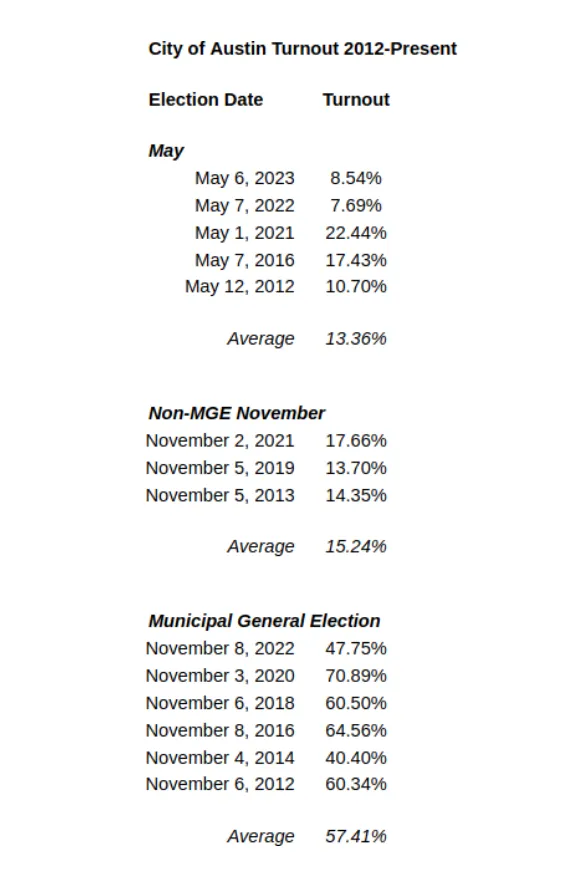
For all May elections, turnout is just 13% on average. It's 15% for odd-year November elections. Still pretty terrible. It is a healthy 57% (about 515,000 voters) for even-year November elections.
That's a huge difference!
When we say that "Austin voters" have decided policy topic XYZ, it should be the biggest and most inclusive version of "Austin voters". This keeps policy responsive to the true Austin majority. And over time, it also undermines extreme voices and supports policy coherence by preventing knee-jerk reactionary changes brought about by quirky low-turnout electorates. Stability through consistent inclusivity.
History Refutes Proposition G Critics
Let's address the main criticisms made against this proposal.
Overwhelmingly, criticism of Proposition G focuses on its effect on citizen-initiated ordinance ballot measures. Having the Charter voted on by the broadest electorate is much less controversial because it's the "Constitution" of the City and state law makes it clear that the Charter isn't supposed to be amended constantly. For example, the Texas State Constitution requires a 2-year blackout between charter amendment elections. The Charter is not meant to be "always on" for groups trying to make narrow policy changes.
The main argument against moving ordinance votes to even-year Novembers is that groups petitioning will "have to wait two years to get heard."
For that to be true, it would require citizen-initiated policy elections to take place almost exclusively during odd-year May elections. But the election history data for the last 20 years doesn't back that up.
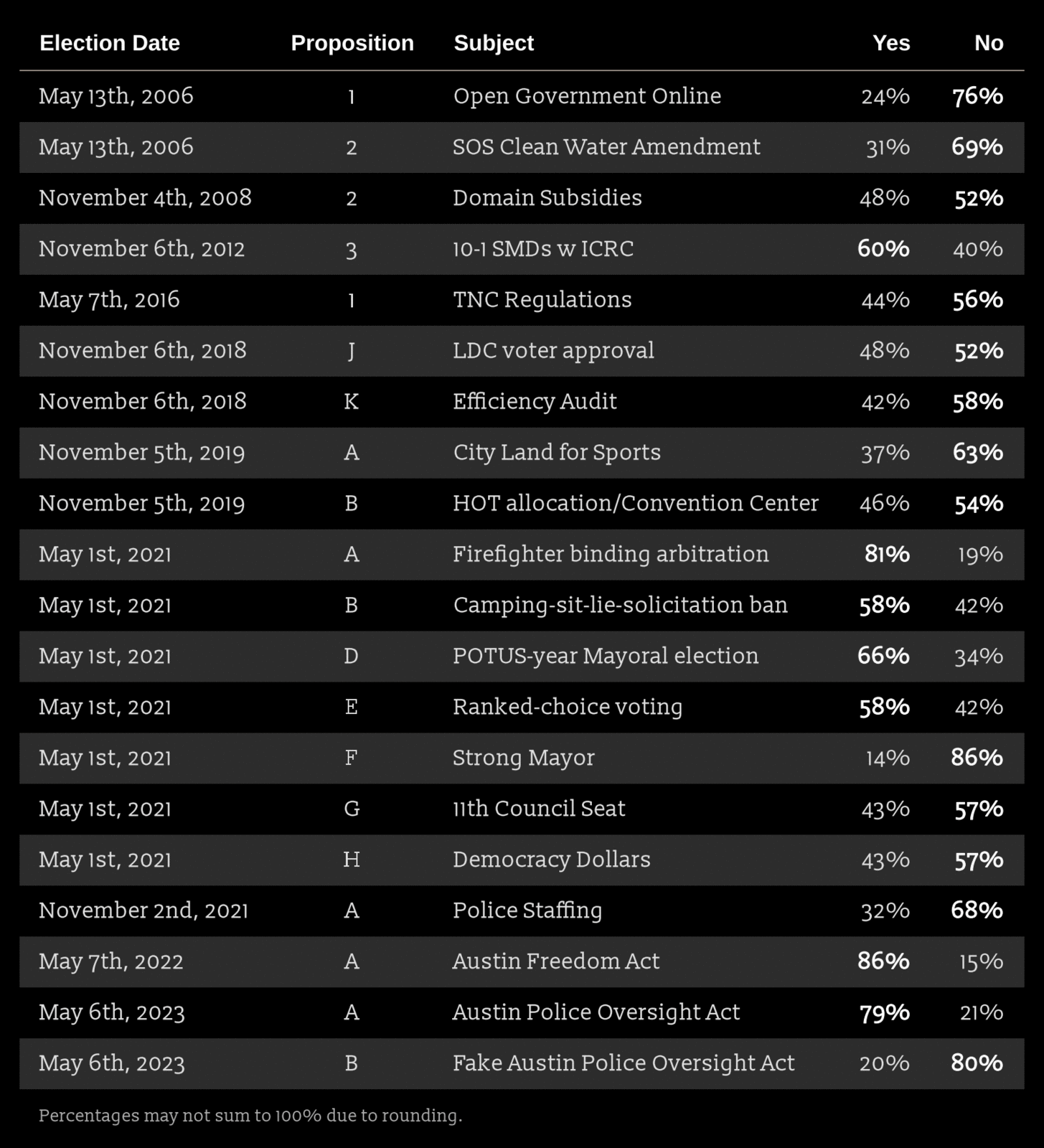
The table above lists the policy-focused ordinance and charter amendment propositions for the last 20 years. The table reveals that the majority of propositions were not voted on during an odd-year May election (the one farthest away from an even-year November). But only 4 of the 20 were voted on during the high turnout even-year November election. So, Proposition G isn't disrupting an imagined system of citizen-initiated odd-year May elections - just a pernicious overuse of low-turnout elections.
More importantly, there is not a single example in the last twenty years of a successful citizen-initiated policy ballot measure that (a) passed overwhelmingly (>66%) and (b) was opposed by a majority of City Council. The reality is that citizen-initiated ballot measures have not been used as an "emergency brake" on out-of-touch City Councils. That's why the failure rate is 65% overall.
Instead of authentic grassroots revolts, petitioned ordinance initiatives are typically deployed (and timed) by formal, organized groups to achieve their donors' peculiar political objectives. If you look at the last twenty years, sometimes those donors are right, sometimes left, and sometimes just quirky. Achieving those objectives tends to require the variance from low turnout electorates; if it were popular with the typical voter from a high turnout November election, it would already be viable via conventional advocacy and deliberation at City Council.
Having these groups adjust their petitioning calendars to target the higher turnout elections may be an inconvenience to them, but it ensures that if their policies are adopted they actually reflect Austin's majority. For genuine "emergency brake" situations featuring grassroots ordinance petitions, the Charter already has a clause requiring City Council to decide whether to call an election on said ordinance or "pass the ordinance exactly as written within 10 days."
The other argument made against Proposition G, unsurprisingly, is that November voters are "uninformed" and "disengaged" from local policy matters.
That's a bit silly and harks back to Austin's previous eras of surreptitious voter disenfranchisement.
City Council "super fans" are not the only voters with sufficient intellect, reasoning power, and access to background information to cast a vote that aligns with their preferences. In reality, if an individual doesn't see that they have enough information, they just skip that ballot question. The majority is still determined by voters who deem they have enough information to make a choice.
Avoiding Pricey Boutique Elections
Proposition G will save money. We've already had a few "boutique" elections because of citizen-initiated ballot measures. The most recent was May of 2023 when dueling police oversight propositions were the only items on the ballot. Turnout for that election was a dismal 8.54%.
There's no official estimate of how much money would be saved by Proposition G over, say, the next 20 years. The CRC was presented with data showing that just the simple processing and administration of the citizen petition process can run the City Clerk from $50,000 to $80,000 per election date. The bigger expense is covering the cost of running the election. Estimates range between $500,000 and $1.25 million because sometimes these boutique citizen-petitioned elections can share costs with other communities in Travis County. Otherwise, it's just the City of Austin paying for the entire election. Sure, these are not game-changing amounts for one's property tax bill. The point is that the status quo encourages these wasteful, inefficient elections that also happen to go against the bedrock democratic idea of majority rule.
To conclude, this amendment is, at first glance, boring and technical. True!
But it's actually an important solution to a growing threat to Austin good government. Proposition G fixes a major Austin democracy loophole that is very tempting to extreme groups with deep-pocketed patrons. In this age of decaying democratic norms, it's only a matter of time before some of these groups abuse the loophole to sneakily chip away at majority rule in Austin. We should not wait until the problem gets worse to fix it.