
More than meets the I

The most consequential feature of this November's Proposition I is not its efficiency "audit" report. Instead, it's the new legal right it creates allowing anyone to sue City Council - and potentially hold its budget process hostage - if one doesn't like the conclusions or methodology of the audit. That new litigation entitlement is a Trojan horse that will empower the most extreme voices in Austin to derail sensible City budgeting practices.
Save Austin Now (SAN) - the conservative proponents of Proposition I - argue that their ballot measure's extensive audit report will be (1) a unique budget accountability mechanism that is (2) protected by the special independence created by its placement in the City's Charter.
Both arguments are wrong.
SAN has repeatedly made untrue statements as part of its campaign. For example, the below tweet's claim that the City of Austin "does not get audited" is completely false (the bar chart compares apples-to-oranges by including the cost of Austin's public power utility in the spending calculation, by the way).
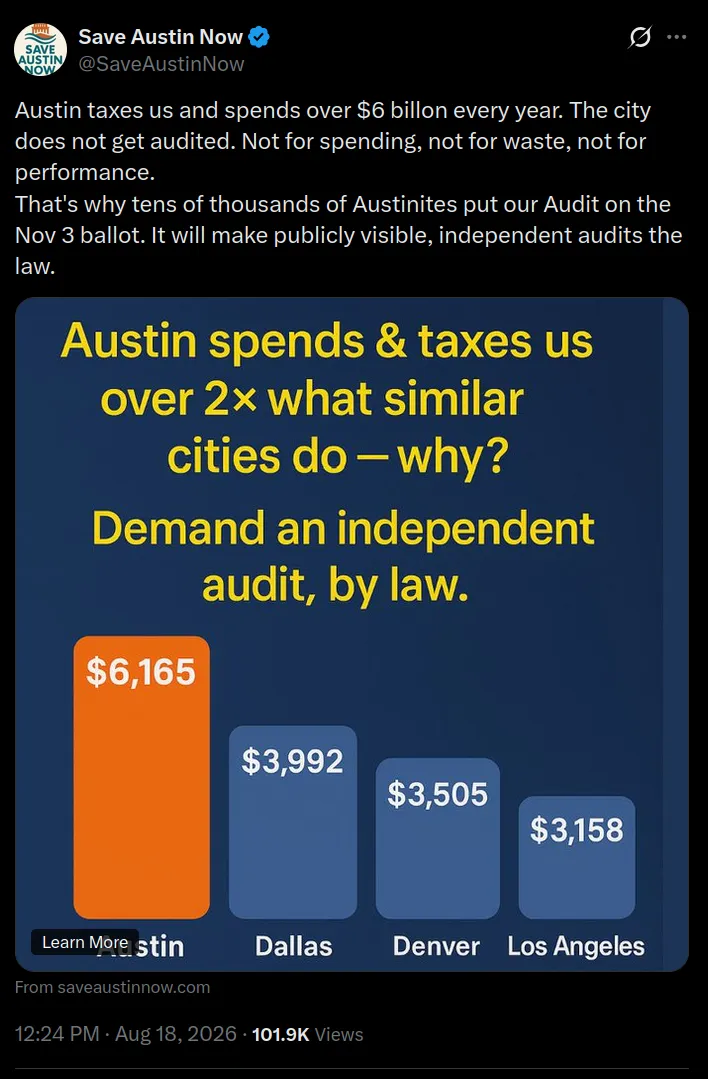
Back in reality, the City of Austin has undertaken GAAP audits for decades. Local governments now call them Annual Comprehensive Financial Reports. The ACFR for 2025 is very real, with a page count of 308. Here it is. You can see its cover in the image below. Article VII, Section 16 of the current City Charter reads: "At the close of each fiscal year, and at such other times as may be deemed necessary, the council shall cause an independent audit to be made of all accounts of the city by a certified public accountant." The City has, as of today, its last 27 digitized audits online.

But that's not all. Since 1993, the City of Austin has had an Independent City Auditor charged with performance reviews, fraud detection, and waste reduction. In the current fiscal year's budget, the Auditor's department received $7.3 million for 29 FTEs. In 2025 alone, they released 16 operational audit reports and 8 fraud investigation reports. And even more reports are on the way. In the wake of Proposition Q's defeat in November of 2025, City Council adopted a Comprehensive Efficiency Audit (CEA) ordinance covering the exact same ground as Proposition I. City Council already approved a $5.2 million contract authorization for a consulting firm (Public Works LLC) to conduct the efficiency audit.
In theory, if Proposition I passes, it should be combined with the CEA to minimize duplication.
But this is where we get to the legal Trojan horse. Section A.4 of Proposition I states: "The Initiative must be repeated and completed every five (5) years after the completion of the first Initiative or more often as required herein. The City Council is hereby prohibited from ordering an election to increase the City’s maintenance and operation ad valorem tax unless an Initiative complying with this Charter provision has been completed within one (1) year before such an election would occur." You can read the full proposition language here.
The Charter can't be changed by an act of the City Council, thus a citizen litigant can sue to compel the City to comply with the adopted policy language. And that's why the granular terms matter.
Bizarrely, the ballot measure does not define what counts as a "completed" audit. Is it delivery by the vendor to the Auditor? City Council voting to accept it as completed? The City Manager certifying it as "completed"? I suspect this was left undefined to make it easier for residents to litigate whether the audit is, in fact, complete. This empowers any individual with the ability to litigate with a soft veto over voter-approved tax rate elections (VATRE) by disrupting the VATRE budget development process. City Council would have to complete an audit within 365 days of the VATRE election, but said completion can be litigated right through the budget process and the potential VATRE election date. That would be a mess. And if you can effectively veto a needed VATRE, the consequences carry over into subsequent budgets, creating the need for another VATRE and repeating the downward spiral.
The expansive, grandiose requirements of the ballot measure text make a lot more sense in this context. Proposition I requires that the audit yield "complete Transparency of Spending and Performance by all City offices and City contracting entities". Complete? All? Those are pretty categorical word choices. Similarly, the ballot measure requires that the audit "benchmark and compare all elements of the operation of the City" and "maximize the Performance of all City offices". Again, these are very high standards being baked in as official requirements, not as goals.
The current conservative backers of Proposition I may see this new, disruptive legal tool as all upside for their causes. They can add substantial process friction to VATREs and force City Council to spend even more on efficiency audits targeting departments and functions they don't like. The problem for them - and for the rest of us - is that ANY individual or group with the resources to litigate can try the same tactic. For example, a police abolitionist group could attempt to soft veto a VATRE for public safety until complete transparency and maximized performance (as they see it) is achieved at the Austin Police Department.
Undermining the City Council's ability to sustainably fund public safety and public order is my main concern with Proposition I. Yet another City Auditor report will not change the City Council candidates and policies the typical voter prefers. But needlessly opening a new path for bad-faith litigation is a real risk. Public safety and public order are the categories that most depend on the City's property taxes; since their costs grow faster than the Texas Legislature's maintenance-and-operations spending caps, they will inevitably need successful VATREs to sustain existing service levels. Creating a new erratic obstacle to sensible VATRE planning threatens public safety.
Finally, let's address the notion that passing this as a charter amendment (as opposed to an ordinance) creates special "independence" that makes it worth the risks. Under Proposition I, the City Auditor also selects the external auditor, exactly the same as with the CEA. So, the City Council can still fire the Auditor or constrain their budget or shoot down their other procurement votes if they don't like the Proposition I audit's direction.
Placement in the Charter does not make it harder for City Council to tamper with the Auditor or the audit process. It certainly makes it harder to change the policy's text, but that also means City Council can't fix the problems that will arise with the legislation. This is another indication that what the Proposition I proponents actually want is a new legal tool to override the City’s duly elected officials. The efficiency report is just the seemingly harmless offering needed for this trick to work.