
Notes on CEA Committee Hearing
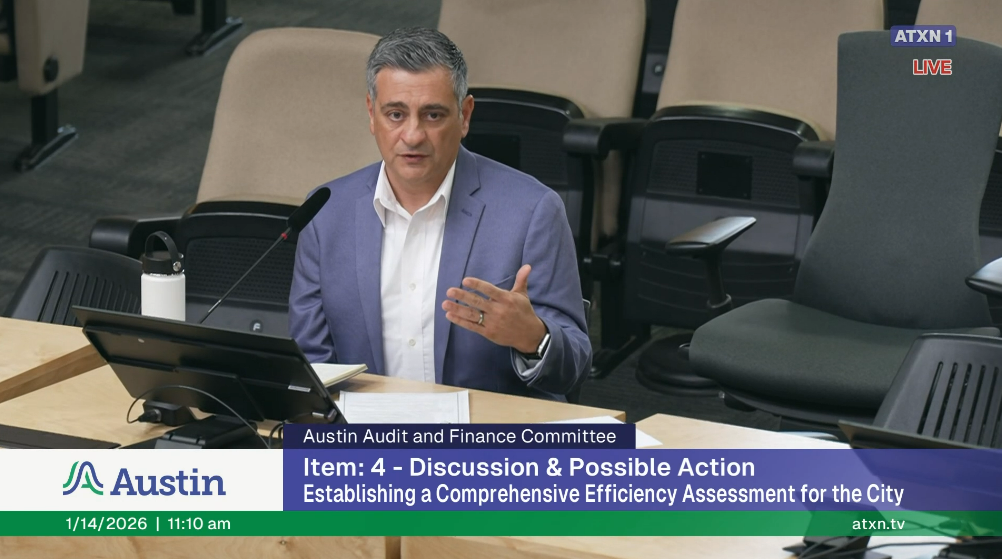
Yesterday marked "CEA Day" at the Austin City Council Audit and Finance Committee. Following the Mayor’s proposal for a Comprehensive Efficiency Assessment (CEA), the committee began digging into the operational realities of auditing every city department.
While the spirit of the initiative remains promising, the discussion highlighted several issues with the current proposal. Here are the four critical developments from the session.
1. The Risk of a "Blank Check"
The most immediate concern was the ambiguity surrounding cost. Under questioning from Council Members Fuentes and Laine, City Auditor Jason Hadavi appeared uncomfortable providing a firm cost estimate for the proposed ordinance.
This is troubling. The proposal implies a significant volume of work (30 to 40 audits per "cycle"). Based on comparable projects in Austin and peer Texas metros, these engagements often range from $100,000 to $500,000 each. With the Auditor’s Office operating on a roughly $5 million annual budget, a lack of precise forecasting is a red flag.
The City cannot embark on a massive efficiency exercise without understanding the financial obligations it creates. This is doubly important because the product here is reports. Not housing or parks or library hours. Reports. If the Auditor cannot provide firm numbers now, Council must institute the per-capita spending caps suggested in our previous analysis to prevent the irony of an anti-waste initiatives becoming a waste itself.
2. Clarifying the Audit Cycle
There was significant confusion regarding the duration of the audit "cycle". The language of the proposed ordinance suggests a blistering three-year rotation. However, Hadavi muddled through clarifyin his intent: a roughly five-year period to cover all departments and enterprises, followed by a three-year pause.
This "5-on, 3-off" cadence is operationally superior to a perpetual three-year grind.But if the intent is an eight-year aggregate cycle, the ordinance must explicitly state this. We cannot rely on ad hoc verbal assurances during a committee hearing to govern a likely permanent, cyclical, multi-year procurement program.
3. The Case for an Independent Budget Analyst (IBA)
Council Member Ryan Alter raised the vital question of establishing a San Diego-style Independent Budget Analyst (IBA). In my opinion, this is the structural "efficiency" reform Austin policymakers should actually prioritize.
Now, many civic insiders make a somewhat naive assumption that Austin's Council-Manager system follows the same political dynamics as the vast number of smaller municipalities - from New England towns to small Sun Belt cites - that rely on the system for governance. In my view, Austin is simply too big to be analytically lumped in with those types of communities. Council Members - with 3-4 total staff members per office - can't be expected to have sufficient analytical capabilities to provide adequate oversight over a $6 billion operation serving a million people.
In Austin, functionally, the City Manager acts as an unelected strong mayor with overwhelming control over a vast bureaucracy. They are more like the operational side of a Big City Mayor, not like a top civil servant of a small town. To achieve structural balance, Council needs its own analyitical capacity for oversight. It needs independent civil servants who can scrutinize the City massive budget and performance 24/7/365.
Unsurprisingly, City of Austin CFO Ed Van Eenoo appeared unenthusiastic about the prospect of an independent body checking the Manager's staff's work. Auditor Hadavi remained pretty silent on the matter. I don't believe he addressed the matter at all or, at least, at any length. This silence underscores the problem as a person the Auditor technically will have to Audit (Van Eenoo) answered a question substantively requiring the Auditor's opinion! It was an moment that concisely revealed exactly why an IBA is needed.
4. Structural Independence for the Auditor
Finally, a sort of potential "sleeper issue" emerged regarding the Auditor’s own budget. Currently, the City Manager proposes the budget for the office that is supposed to investigate the City Manager’s performance. There's a bit of a tension there.
While Hadavi noted his currently "great relationship" with the Manager’s budget team, structural integrity cannot rely on personal relationships. It creates a perverse incentive where a Manager could financially constrain an Auditor who is a little too effective at uncovering inefficiencies.
If the CEA moves forward, the Auditor’s minimum proposed funding should be determined by a Council-approved formula enshrined in an ordinance with a high-treshold for modication, just like the proposed CEA requires nine votes for amendment. This would protect the Audtor from political retaliation by the Manager or Council, reducing a disincentive for the Auditor to publish critical findings. A truly independent watchdog requires an independent wallet.